
As organizations embrace DevSecOps, protecting sensitive credentials has become just as important as securing source code. Every modern application depends on secrets such as API keys, cloud credentials, database passwords, certificates, and service tokens. If these secrets are exposed, the impact can range from unauthorized access to complete infrastructure compromise.
Traditionally, organizations have relied on CI/CD variables or external vault solutions to manage secrets. While effective, these approaches often introduce additional infrastructure, separate permission models, and operational complexity.
With GitLab 19, GitLab introduces GitLab Secrets Manager (Public Beta)—a native capability designed to simplify secret management while strengthening security across the CI/CD lifecycle. By integrating secrets management directly into the GitLab platform, organizations can reduce operational overhead and ensure secrets are only available to authorized pipeline jobs.
Why Secret Management Matters
Secrets are used throughout the software delivery lifecycle to authenticate applications and access critical services. These include:
- Database credentials
- Cloud provider access keys
- API tokens
- TLS certificates
- Service account credentials
- Third-party integration secrets
A common challenge in many CI/CD environments is that secrets are stored as project or group variables, making them accessible to more jobs than necessary. In larger environments, managing permissions across multiple tools and ensuring secrets are rotated securely can become increasingly difficult.
GitLab Secrets Manager addresses these challenges by adopting a least-privilege approach, ensuring secrets are only accessible to the pipelines that require them.
What is GitLab Secrets Manager?
GitLab Secrets Manager is a native secrets management capability available in GitLab 19 (Public Beta) for Premium and Ultimate users.
Unlike traditional CI/CD variables, secrets are securely stored and retrieved only when explicitly requested by an authorized CI/CD job. This minimizes unnecessary exposure and strengthens security across the software delivery lifecycle.
The solution is built on OpenBao, an open-source secrets management platform, allowing GitLab to provide secure storage, access control, and lifecycle management without requiring developers to interact with a separate secrets management interface.
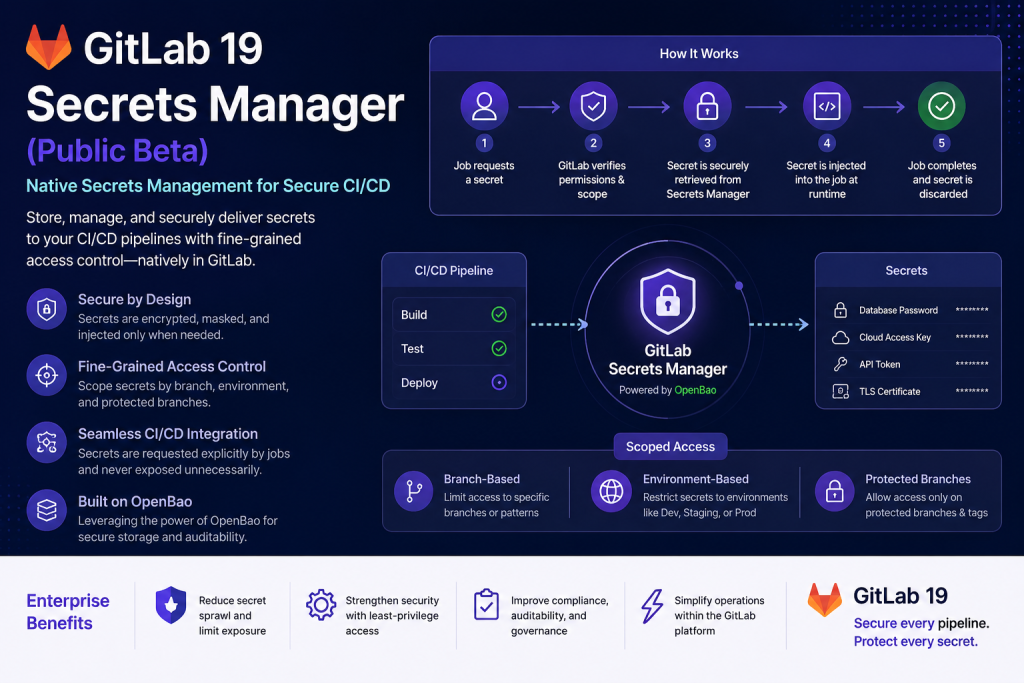
How GitLab Secrets Manager Works
GitLab Secrets Manager integrates directly with GitLab CI/CD pipelines.
When a pipeline is executed:
- The CI/CD job explicitly requests a required secret.
- GitLab verifies the identity of the job.
- Access policies determine whether the job is authorized to retrieve the secret.
- The secret is securely injected into the running job.
- Once the job completes, the secret is discarded and never stored within the repository.
This runtime injection model significantly reduces the risk of accidental credential exposure while maintaining a seamless developer experience.
Fine-Grained Secret Scoping
One of the standout capabilities introduced with GitLab Secrets Manager is granular secret scoping, allowing organizations to define exactly where secrets can be used.
Branch-Based Scoping
Secrets can be restricted to specific branches or wildcard branch patterns, ensuring production credentials are unavailable to feature branches.
Environment-Based Scoping
Different credentials can be assigned to development, testing, staging, or production environments, enabling secure environment isolation.
Protected Pipelines
Secrets can also be limited to pipelines running on protected branches, adding an extra layer of protection for production deployments.
This fine-grained control aligns with the Principle of Least Privilege, ensuring jobs receive only the credentials they require.
Native Integration with GitLab CI/CD
Unlike external secrets management platforms that require additional integrations and maintenance, GitLab Secrets Manager is designed to work seamlessly within the GitLab ecosystem.
Security teams benefit from:
- Unified access control
- Centralized secret management
- Simplified governance
- Reduced operational overhead
Developers benefit from a consistent workflow without switching between multiple platforms.
This integrated approach helps organizations streamline DevSecOps while improving overall security posture.
GitLab Secrets Manager vs Traditional Secret Management
| Capability | GitLab Secrets Manager | Traditional External Vault |
|---|---|---|
| Native GitLab Integration | Yes | Requires integration |
| Fine-Grained Secret Scoping | Yes | Yes |
| Branch & Environment Controls | Yes | Platform dependent |
| Unified Access Management | Yes | Separate access model |
| Operational Complexity | Low | Medium to High |
| Built for GitLab CI/CD | Yes | Requires additional configuration |
Enterprise Benefits
GitLab Secrets Manager helps organizations:
- Eliminate hardcoded credentials from repositories
- Reduce reliance on over-scoped CI/CD variables
- Apply least-privilege access to secrets
- Simplify CI/CD security management
- Improve auditability and governance
- Reduce operational complexity for GitLab-centric environments
For enterprises standardizing on GitLab, native secrets management strengthens security while streamlining DevSecOps workflows.
GitLab Secrets Manager vs Traditional Secret Management
Conclusion
Secrets are one of the most critical assets in modern software delivery, and protecting them should be an integral part of every DevSecOps strategy.
With GitLab 19 Secrets Manager (Public Beta), organizations can securely manage credentials within GitLab, apply fine-grained access controls, and simplify secure CI/CD without exposing secrets unnecessarily.
As GitLab continues to unify the DevSecOps lifecycle, Secrets Manager represents another significant step toward a more secure, integrated, and developer-friendly platform.
About Canarys
For more information on GitLab and DevSecOps solutions, visit:
Or contact us at: gitlab@ecanarys.com
Canarys Automations is one of India’s leading GitLab partners and a GitLab Certified Professional Services Partner (PSP). We help enterprises adopt and scale GitLab through consulting, implementation, DevSecOps transformation, managed services, and GitLab license reselling & enabling secure, efficient, and enterprise-ready software delivery.
“The strongest secret isn’t the one that’s hidden, it’s the one that’s available only to the right pipeline, at the right time, and nowhere else.”