-
GitHub Copilot Fusion: What If AI Models Could Work Together?
Exploring multi-model orchestration and the next step in AI-assisted development. It started with a simple curiosity Whenever I use GitHub Copilot, I often find myself thinking about which model to choose. A quick code change needs one kind of model, while complex debugging or multi-file changes might need something more powerful. Sometimes, I even switch…
-
Governance Lifecycle with the Orgs: How Organizations Govern Their Foundry Control Plane for 1,000s of AI Agents
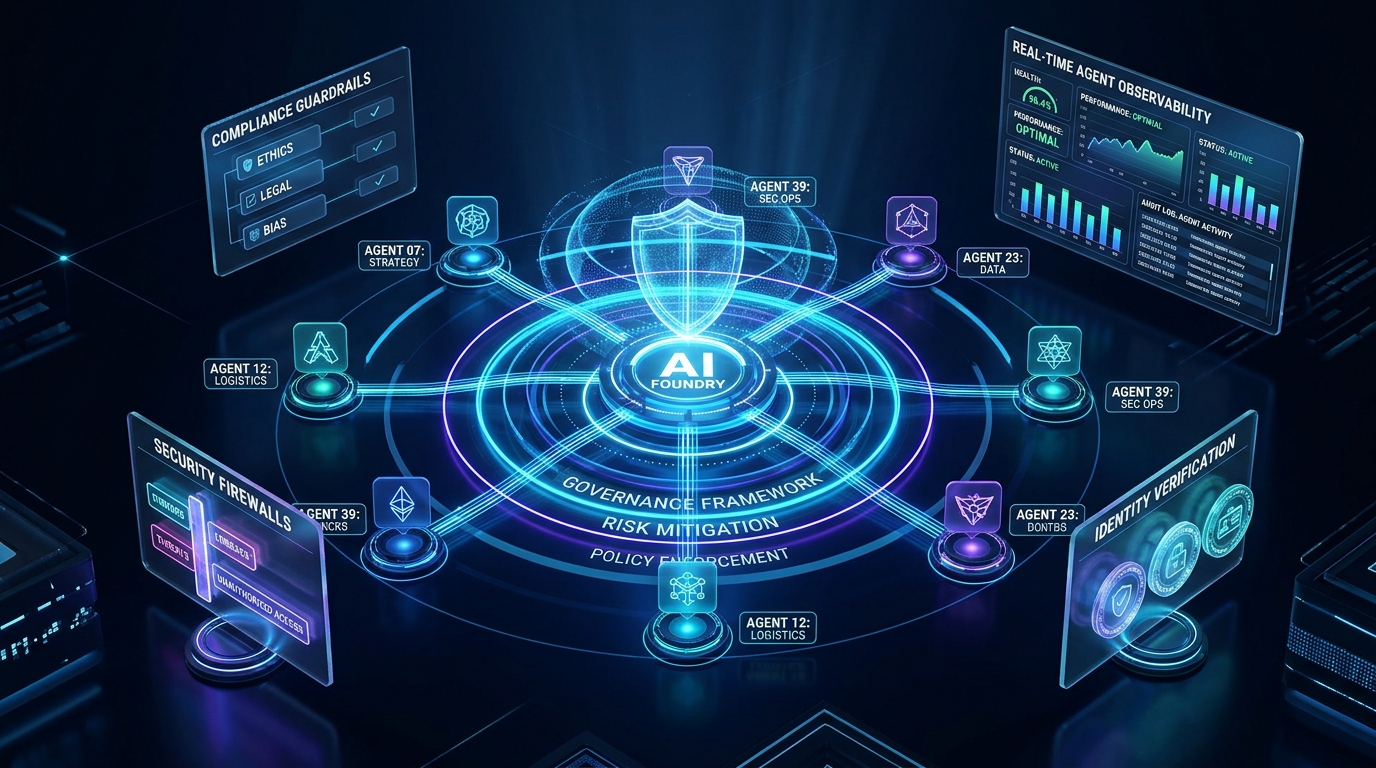
Now-a-days every org runs to build AI agents, but is your agent secure? Join Sandeep as he breaks down how to secure and manage the agent lifecycle end-to-end using the Microsoft AI Foundry Control Plane across Security (Entra Agent ID), Compliance (Guardrails & Policies), Fleet Management (Discovery & Inventory), and Observability (Traces & Evals).
-
Prompt-Based Agents vs Hosted Agents in Microsoft Foundry: How to Choose the Right Architecture
Introduction: One platform, two ways to build agents AI agents are moving beyond simple question-and-answer experiences. They can search information, call APIs, analyze files, coordinate multiple steps, and interact with business applications. As these solutions become more complex, developers need to decide not only which model to use, but also how the agent itself should…
-
Beyond OCR: Unlocking Business Insights with Azure AI Content Understanding
The problem with unstructured business data Most of the information a company runs on does not live in a database. It lives in invoices, contracts, scanned forms, email attachments, call recordings, meeting videos and product photos. Someone has to read, listen to or watch that content, decide what matters, and type it into a system.…
-
I Started Exploring Microsoft Foundry — and Foundry IQ Caught My Attention
I’ve been spending some time exploring Microsoft Foundry, and one thing became clear pretty quickly: Building an AI application is no longer just about picking a good AI model. The model is important, of course. But once we start thinking about real enterprise applications, a lot of other questions come up. What data should the…
-
Fraud Detection in Real Time: How Agentic AI Is Changing Risk Management
Agentic AI is changing fraud detection by moving risk management from rule-based reaction to autonomous, real-time decision-making. Unlike traditional systems that rely on static rules and batch processing, Agentic AI can continuously analyze transactions, identify anomalies, assess risk, and initiate appropriate actions with minimal human intervention. Why Real-Time Fraud Detection Matters Fraud patterns can change…
-
MLOps Best Practices for Deploying and Maintaining Custom AI Models
Custom AI models deliver business value only when they are deployed, monitored, and continuously improved through a mature MLOps strategy. MLOps best practices ensure reliable AI model deployment, automated monitoring, governance, and lifecycle management, helping organizations reduce operational risks while accelerating AI innovation. For enterprises scaling AI initiatives, MLOps is no longer optional; it is…
-
Building an AI Center of Excellence: Where to Start Your Agentic Rollout
Organizations achieve better outcomes with agentic AI when they establish an AI Center of Excellence (AI CoE) before scaling enterprise-wide deployments. An AI CoE provides governance, reusable frameworks, security standards, and business alignment that enable AI initiatives to move from isolated pilots to measurable business value. Many enterprises launch AI projects successfully but struggle to…
-
Retrieval-Augmented Generation in 2026: Beyond the Hype Cycle
Retrieval-Augmented Generation (RAG) has evolved from an emerging AI concept into a practical enterprise technology. In 2026, organizations are no longer asking whether they should adopt RAG—they are evaluating how to deploy it securely, accurately, and at scale. By combining large language models (LLMs) with real-time access to trusted business data, RAG enables AI systems…