
I’ve been spending some time exploring Microsoft Foundry, and one thing became clear pretty quickly:
Building an AI application is no longer just about picking a good AI model.
The model is important, of course. But once we start thinking about real enterprise applications, a lot of other questions come up.
What data should the AI use?
Which tools should it be able to access?
How do we evaluate its responses?
How do we monitor it in production?
And probably the most important one:
How do we make sure the AI has the right context?
That’s where Microsoft Foundry starts to get interesting.
From “Which model?” to “What are we building?”
When we first started working with generative AI, a common question was:
“Which model should I use?”
Today, the conversation is changing.
We are building applications where an AI model needs to reason, use tools, interact with data, follow instructions, and sometimes perform tasks on our behalf.
Microsoft Foundry brings many of these capabilities together for building and managing AI applications and agents.
So I started looking at Foundry less as just a place to access models and more as a platform around the entire AI application lifecycle.
And then I came across something particularly interesting — Foundry IQ.
What if the AI doesn’t know our business?
Let’s take a simple example.
Imagine we build an HR assistant.
I ask:
“What is our company’s parental leave policy?”
The AI model probably understands what parental leave means.
But does it know my company’s policy?
Not unless we give it access to that information.
The actual policy might be sitting in company documents, SharePoint, or other enterprise knowledge sources.
This is where Foundry IQ comes into the picture.
Foundry IQ — giving agents access to the right knowledge
Foundry IQ provides a knowledge layer that agents can use to work with enterprise information.
The idea is quite simple:
Enterprise data → Knowledge sources → Foundry IQ knowledge base → Agent → Grounded response
What I found particularly interesting is the use of agentic retrieval.
Instead of treating every question like a simple search, a complex question can be broken down into smaller queries. Relevant information can be retrieved and ranked before being provided to the agent.
This becomes especially useful when the answer isn’t sitting neatly in one document.
But what about access?
This is where enterprise scenarios get even more interesting.
Suppose I ask the HR assistant about a policy.
The AI shouldn’t suddenly get access to every HR document in the organization.
Having access to information and being allowed to see information are two different things.
Foundry IQ is designed to work with permissions and access controls from supported knowledge sources, helping retrieval respect the user’s authorization.
For enterprise AI, this is critical.
We don’t just want:
“Give me an answer.”
We want:
“Give me the right answer, using information I’m actually allowed to access.”
The bigger Foundry picture
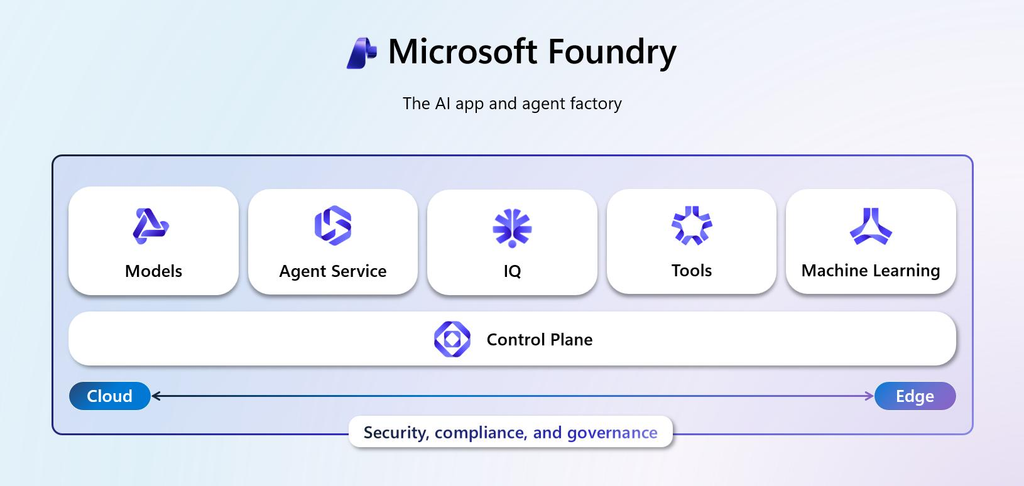
The way I’m currently looking at Microsoft Foundry is something like this:
Models
→ Provide intelligence
Agents
→ Reason, use tools and perform tasks
Foundry IQ
→ Helps agents work with enterprise knowledge
Microsoft Foundry
→ Provides the broader environment to build, evaluate, monitor and govern AI applications
And suddenly the picture becomes much bigger than just a chatbot.
We are moving from:
“Let’s add AI to our application.”
to:
“Let’s build an application that can understand our business context, use the right tools, work with our data and operate within enterprise controls.”
One thought I’m taking away
The more I explore AI, the more I feel that intelligence alone isn’t enough.
A model can be extremely capable and still give us a poor answer if it doesn’t have the right context.
The real value starts to appear when we combine:
Intelligence + Context + Tools + Data + Governance
That’s what makes the Microsoft Foundry ecosystem interesting to me.
I’m still exploring the Foundry ecosystem, but this was one of the concepts that stood out to me. More to explore!