
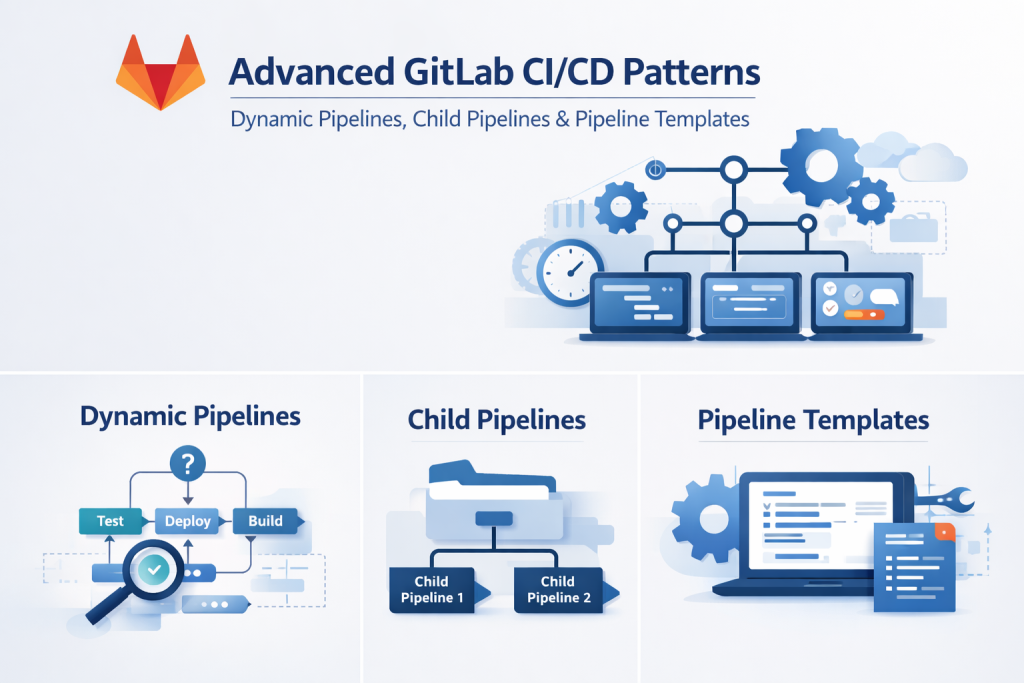
As software systems grow in complexity, traditional CI/CD pipelines often become difficult to manage, maintain, and scale. Large monolithic pipeline configurations can slow down execution, reduce visibility, and increase operational overhead.
To address these challenges, GitLab CI/CD provides advanced pipeline design patterns that enable teams to build modular, scalable, and efficient automation workflows.
Within the unified GitLab platform, features such as dynamic pipelines, parent-child pipelines, and reusable pipeline templates help organizations standardize and optimize CI/CD across complex environments.
Dynamic Pipelines
Dynamic pipelines allow CI/CD workflows to adapt based on context, rather than relying on static definitions.
Instead of executing the same set of jobs for every change, pipelines can be structured to trigger only the necessary workflows depending on:
a) Code changes
b) Affected services
c) Environment conditions
This approach is especially useful in monorepos and microservices architectures, where different components evolve independently.
By reducing unnecessary pipeline executions, dynamic pipelines improve:
a) Pipeline efficiency
b) Resource utilization
c) Overall execution time
Parent–Child Pipelines
Parent-child pipelines introduce a modular structure to CI/CD workflows.
Instead of maintaining one large pipeline configuration, organizations can break pipelines into smaller, independent units that are triggered by a parent pipeline.
This enables:
a) Separation of concerns across services or components
b) Parallel execution of multiple pipelines
c) Better maintainability and readability
In enterprise environments, this pattern is widely used to manage multiple applications, services, or deployment environments within a single repository or platform.
Pipeline Templates
Pipeline templates provide a mechanism to standardize CI/CD configurations across projects.
Common workflows such as:
a) Build processes
b) Security scans
c) Code quality checks
d) Deployment steps
can be defined once and reused across multiple repositories.
This ensures:
a) Consistent DevSecOps practices
b) Reduced duplication
c) Easier governance and compliance enforcement
Templates are particularly valuable in large organizations where maintaining consistency across teams is critical.
Why These Patterns Matter
For enterprises operating at scale, these advanced pipeline patterns are not just optimizations, they are essential for managing complexity.
By adopting these approaches, organizations can achieve:
a) Modular and scalable pipeline architecture
b) Faster execution through parallelism
c) Standardized workflows across teams
d) Reduced maintenance overhead
e) Improved visibility and governance
These capabilities make GitLab CI/CD a strong choice for organizations adopting modern DevSecOps and cloud-native architectures.
Conclusion
As CI/CD pipelines evolve from simple automation workflows to complex orchestration systems, the need for flexibility and scalability becomes critical.
Features like dynamic pipelines, parent-child pipelines, and reusable templates enable teams to design efficient, maintainable, and enterprise-ready CI/CD systems within GitLab.
By leveraging these advanced patterns, organizations can move beyond basic automation and build intelligent, scalable DevSecOps pipelines.
About Canarys
For more information on GitLab and DevSecOps solutions, you can visit our website: https://ecanarys.com/gitlab-solutions/
Or contact us at: gitlab@ecanarys.com
Canarys Automations is one of the leading GitLab partners in India and a GitLab Certified Professional Services Partner (PSP). We help enterprises adopt, implement, and scale GitLab by providing consulting services, implementation support, and GitLab license reselling, enabling end-to-end DevSecOps transformation.
“Scalable CI/CD isn’t about adding more jobs, it’s about designing smarter pipelines.”