
The Modern Software Development Lifecycle is moving faster, and security threats are moving even faster than Software Development. From a small, leaked credentials to any vulnerable libraries or dependencies, these trivial mistakes in the code can lead to a major serious incident. So GitLab, being a DevSecOps (Development + Security + Operations) tool, provides a set of built-in security capabilities designed to catch these problems in early stages.
Why Secure Development Matters
So, during the software development process, the developer teams work with the below sensitive information:
a) API Keys
b) Cloud Secret and Access Tokens
c) Personal Access Tokens
d) DB credentials
e) Private certificates and keys
If these types of sensitive secrets and vulnerable information are accidentally committed to a repository, they can be quickly identified and exploited by the attackers. GitLab’s built-in security features help to prevent these vulnerabilities in early stages of the software development lifecycle.
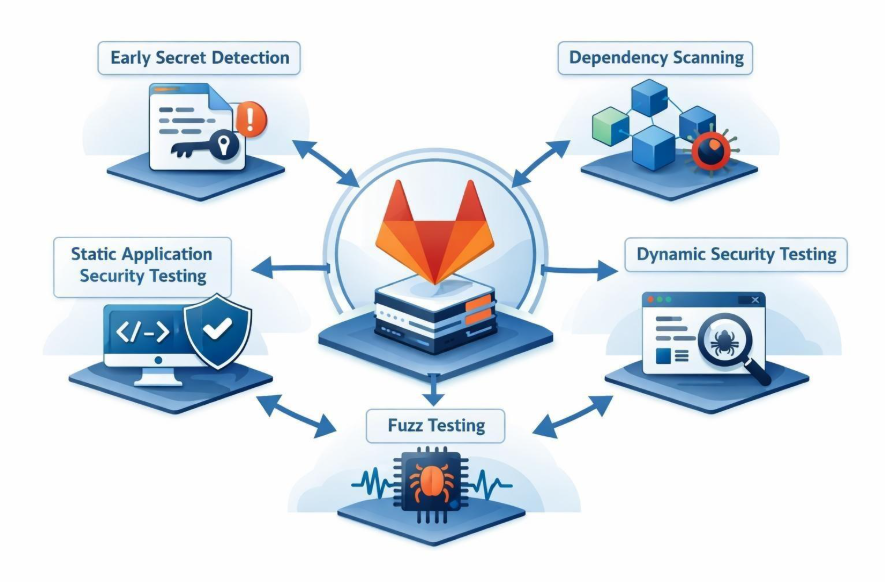
Securing the secrets and credentials from entering the repositories
The most common mistake done by the developers is accidentally committing the secrets or credentials into the source code.
Early Secret Detection
GitLab can help you to detect vulnerabilities in the early stages of the software development lifecycle. Before getting merged into the main repository, the secrets are checked, reducing the risk of exposure. In addition to this, GitLab scans the code again during the automated build pipelines if something slips through.
These approaches help teams:
a) Prevents credential leaks
b) Enforce secure development practices
c) No manual reviews to catch the issues
Securing Third-Party Dependencies
To speed up development, most of the applications depend on the external libraries and dependencies, which increases the risk of security threats.
Dependency scanning
Dependency scanning checks vulnerabilities on the external libraries and applications that depend on them by comparing them against the known vulnerability databases. When a known vulnerability is detected, GitLab highlights it, enabling teams to:
a) Replace the risky dependencies
b) Update to safer versions
This process is known as Software Composition Analysis (SCA).
Static Application Security Testing (SAST)
Static Application Security Testing (SAST) is a core component of a DevSecOps approach, where security is integrated directly into the development lifecycle. In GitLab, SAST analyzes application source code without executing it, automatically scanning for common coding errors and insecure patterns that could be exploited by attackers.
By embedding SAST into CI/CD pipelines, GitLab enables teams to identify and remediate security vulnerabilities early—often before the code is merged or deployed. Since SAST focuses entirely on the code rather than the running application, developers receive fast, actionable feedback at the earliest stages of development.
This shift-left security model helps teams reduce risk, lower remediation costs, and deliver secure software faster. As part of GitLab’s DevSecOps platform, SAST empowers organizations to build security in from day one, rather than treating it as an afterthought.
GitLab SAST Analyzers:
a) Semgrep
b) GitLab-advanced-sast
c) Kubsec
d) PMD-Apex
e) Sobelow
f) SpotBugs
Dynamic Application Security Testing (DAST)
Not all vulnerabilities can be detected in source code alone. Some security issues only surface when an application is running in a live environment. Dynamic Application Security Testing (DAST) is designed to identify these runtime vulnerabilities by testing the application from an attacker’s perspective.
In GitLab Enterprise, DAST scans the running web applications by simulating real-world attacks. It sends crafted requests to the application and analyzes the responses to uncover security weaknesses.
It helps to detect some vulnerabilities like:
a) Cross Site Scripting (XSS)
b) SQL injection
c) Misconfigured servers
d) Exposed Error messages
By integrating DAST into CI/CD pipelines, GitLab enables teams to continuously test live applications and identify vulnerabilities that static analysis might miss. This complementary approach helps organizations achieve end-to-end security coverage, ensuring applications are not only built securely but also remain secure in production.
Fuzz Testing, Finding Bugs with Unexpected inputs
Fuzz testing is a built-in security capability in GitLab that helps uncover application weaknesses by sending random, malformed, and unexpected inputs to a running application. The goal is to identify issues such as crashes, hangs, memory corruption, and potential security vulnerabilities that may not surface during standard testing.
As part of GitLab’s DevSecOps approach, fuzz testing focuses specifically on how an application handles input rather than testing user workflows or user interface behavior. By stressing input validation and error handling, it exposes edge cases that attackers could exploit.
Two types of Fuzz testing:
a) Coverage Guided Fuzzing
b) Behavioral Fuzzing
Since fuzz testing operates against a live application, it is considered a form of dynamic testing. When integrated into CI/CD pipelines, GitLab fuzz testing enables teams to continuously detect deep and hard-to-find vulnerabilities, further strengthening application security throughout the software development lifecycle.
“SAST secures the code you write. DAST secures the application you run. Together, they form the foundation of modern DevSecOps.”
For more information on GitLab solutions, you can visit our website: https://ecanarys.com/gitlab-solutions/
Or contact us at: gitlab@ecanarys.com